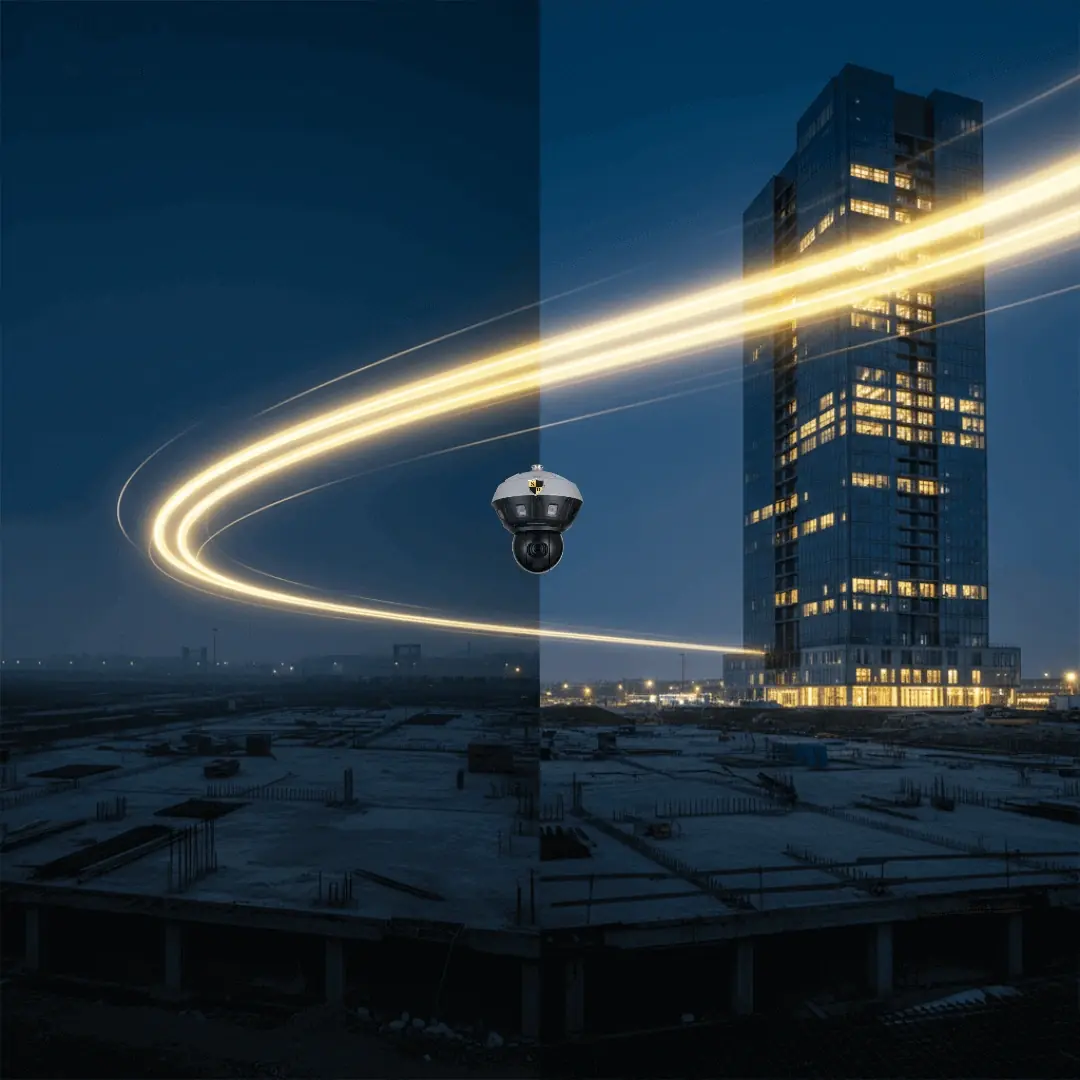
8K Time-Lapse Camera Technology for Construction
This page covers the hardware and software behind our construction time-lapse: 8K multi-sensor cameras, capture scheduling, LTE failover, cloud storage and crane or pole mounts.
Secure Defence is a live video monitoring company. Since 2015, our trained, licensed operators have watched client cameras live, 24/7, from our own command centre in Richmond, BC. We serve Metro Vancouver and all of Western Canada. Time-lapse cameras run on the same system as our 24/7 live video monitoring.
See how businesses use it: construction time-lapse service.
The camera: 8K multi-sensor imaging
Our 8K time-lapse camera uses more than one image sensor in a single housing. The images are combined into one very large, very sharp frame. At 8K, you can zoom in on a single floor, a crane hook or a delivery on the ground and still see detail, from a camera mounted far above the site.
A high-resolution frame also means one camera can cover more of the site. Instead of several cameras pointed at different corners, one well-placed 8K camera can often capture the whole build.
Capture scheduling
You choose how often the camera takes a photo, at any interval from every 10 minutes to every hour.
- Working hours. Capture can be limited to the hours your crews are on site, so the final video isn't full of empty nights.
- Workdays. Weekends and holidays can be skipped.
- Changes over time. The interval can change as the job moves from excavation to structure to finishing.
Power and connectivity
The cameras run on site power. Photos upload over a wired or Wi-Fi connection, with LTE failover. If the main connection drops, the camera switches to LTE cellular and keeps uploading, so you don't lose days of photos to a network problem.
Mounting: crane, adjacent building or pole
- Crane mount. A camera on the tower crane looks down on the whole build as it rises.
- Adjacent building. A mount on a neighbouring roof or wall gives a side view of the building going up.
- Pole mount. A wooden or metal pole on site, for low-rise work, site servicing and large horizontal projects.
Cameras sit in weatherproof housings, and our equipment is rated to -40°C. As the job changes, a camera can be moved to a new mount.
Storage, viewer and video generation
- Cloud storage. Every photo uploads to secure cloud storage as it's taken.
- Viewer. Your team opens a project link on a phone or computer to see the latest photo, step back through past days and download images.
- Video generation. The system compiles photos into time-lapse clips at the milestones or intervals you choose, plus a final video at the end of the project.
Planning the view
A few technical choices at the start decide how the final video looks.
- Height. Higher mounts show more of the site and keep cranes and hoarding from blocking the view.
- Angle. A view from one corner shows two faces of the building, which reads better than a flat front view.
- Sun. Pointing away from the sun avoids glare and dark, backlit frames, especially in winter when the sun sits low.
- Future blockers. We check for buildings, trees and other cranes that may block the view later in the project.
- A fixed frame. Once the camera is set, it stays put, so every photo lines up and the final video doesn't jump.
Same hardware as your security system
Time-lapse cameras can share poles, power and internet with the cameras our operators watch for security. Our system health checks watch every camera, so one that stops uploading gets flagged and fixed. The time-lapse camera itself sits on a site that's monitored live, which helps keep it safe.
If you're building in the Lower Mainland, see our Vancouver construction time-lapse page. Our cameras are used on construction sites and on projects for strata and property management, retail, commercial and industrial and warehousing clients.
Hardware specs
- Camera. 8K multi-sensor time-lapse camera
- Capture interval. Any interval from every 10 minutes to every hour
- Connectivity. Wired or Wi-Fi, with LTE failover
- Storage. Cloud storage, uploaded as photos are taken
- Mounting. Crane, adjacent building or pole
- Operating temperature. Equipment rated to -40°C
- Housing. Weatherproof
- Power. Site power
Book your free site assessment
We'll look at your project and recommend the best camera position and capture schedule.